A Residential Homestead Exemption reduces the taxable value of your home, lowering the amount you owe in Texas property taxes each year. If you recently bought a home or this is your first time applying, understanding the requirements and deadlines will help you maximize your savings.
What Is a Homestead Exemption in Texas?
A homestead exemption removes a portion of your home’s value from taxation. By lowering your taxable value—not your market value—you pay less in property taxes annually.
To qualify:
- You must own the home.
- It must be your primary residence on January 1 of the year you are applying.
- Your driver’s license address must match the home’s address as proof of residency.
Tip: When you purchase a home you live in full-time, it becomes your primary residence, making you eligible for the exemption.

When Can You Apply?
You may submit your Texas Homestead Exemption application anytime between:
📅 January 1 – April 30
Applying early helps ensure your exemption is processed before tax bills are calculated.
How Does the Homestead Exemption Work?
Texas offers a general $100,000 Residence Homestead Exemption. Additional exemptions may be available if you are:
Example: How Your Savings Are Calculated
If your home is appraised at $300,000 and you receive the $100,000 general exemption, your taxable value becomes:
➡️ $200,000
Property taxes are based on your appraisal district’s assessed value, not what you paid for your home.
How Often Is Your Home Appraised?
County appraisal districts reassess property values at least once every three years. Learn more about Valuing Property at Comptroller.Texas.gov by clicking here.
How to Apply for a Texas Homestead Exemption
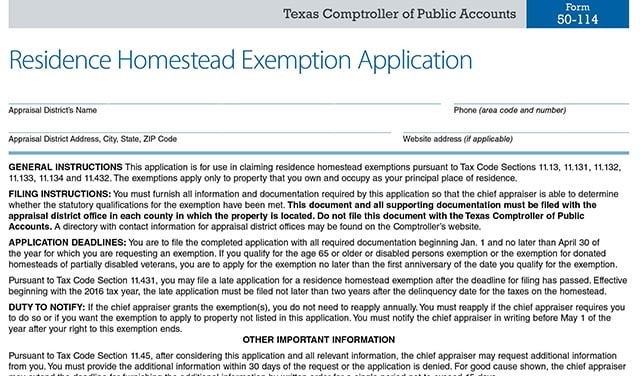
To file your exemption, complete the Residential Homestead Exemption Application.
At the top of the form, you must list your county appraisal district’s name, phone number, mailing address, and website. You can submit your application online or by mail depending on your county.

County-Specific Filing Instructions
Below are direct filing details for two major Texas counties:
Bell County – How to File Your Homestead Exemption:
Residents of Bell County must sign in or register to file online by clicking here.
Tax Appraisal District of Bell County
📞 254-939-5841 (Belton)
📞 254-771-1108 (Temple)
📬 P.O. Box 390, Belton, TX 76513
🌐 www.bellcad.org
Brazos County – How to File Your Homestead Exemption:
Residents of Brazos County can now file online by clicking here.
Brazos Central Appraisal District
📞 979-774-4100
📍 1673 Briarcrest Dr #A-101, Bryan, TX 77802
🌐 www.brazoscad.org
More Resources
For official guidelines and statewide FAQs, visit:
➡️ Texas Comptroller – Residence Homestead Exemption FAQs
Editor's Note: This post was originally published in January 2018 and has been updated to reflect the most accurate information.
Frequently Asked Questions About the Texas Homestead Exemption
1. What is a Homestead Exemption in Texas?
A Homestead Exemption in Texas is a property tax benefit that reduces the taxable value of your primary residence. By lowering your taxable value, you pay less in property taxes each year.
2. Who qualifies for the Texas Homestead Exemption?
You qualify if you own your home and it is your primary residence as of January 1. Your driver’s license must show the same address as your home to prove residency. Additional exemptions are available for homeowners who are 65 or older or disabled.
3. When can I apply for a Texas Homestead Exemption?
You can apply anytime between January 1 and April 30. Filing early ensures your exemption is processed before property tax calculations begin.
4. How much can I save with a Homestead Exemption in Texas?
The standard Texas homestead exemption for school district taxes is currently $140,000 of your home's value. Additional exemptions are available for seniors and disabled homeowners, potentially totaling up to $200,000 for school taxes.
These amounts are effective for the 2025 tax year, following legislative changes and voter approval of a constitutional amendment in November 2023.
Exemption Details:
- Standard Homestead Exemption: All qualified Texas homeowners can subtract $140,000 from their home's appraised value for the purpose of calculating school property taxes.
- Ages 65 or Older / Disabled Homeowners: Eligible individuals can receive an additional exemption. Combined with the standard exemption, this totals $200,000 in exemption for school taxes. This demographic may also have their school taxes frozen at a specific level.
- Disabled Veterans: Veterans with a 100% service-connected disability rating are entitled to a total (100%) exemption from all property taxes on their residence homestead. Partial exemptions are available based on the disability percentage for others.
- Local Optional Exemptions: Cities, counties, and special districts can offer their own local homestead exemptions in addition to the state-mandated ones, which vary by location.
5. Does the Homestead Exemption use my purchase price or appraised value?
Your exemption is based on your appraised value, not what you paid for your home. County appraisal districts review property values at least once every three years.
6. How do I apply for a Homestead Exemption in my county?
You must complete the Residence Homestead Exemption Application and submit it to your county’s appraisal district. Many counties—including Bell County and Brazos County—allow online filing.
7. Can I file my Homestead Exemption online?
Yes. Most major county appraisal districts now offer online applications. Check your county’s appraisal district website for the specific filing link and requirements.
8. Do I need to update my driver’s license to apply?
Yes. Texas requires that your driver's license or state ID show the same address as the home you’re claiming as your primary residence.
9. Can I claim a Homestead Exemption on a second home or investment property?
No. A Homestead Exemption can only be claimed on your primary residence. Second homes, rental properties, and investment homes are not eligible.
10. What happens if I move to a new home?
When you move into a new primary residence, you can apply for a new Homestead Exemption the following January. Be sure to update your driver's license address before applying.
11. Does my Homestead Exemption expire or need to be renewed?
No. Your Homestead Exemption automatically renews each year as long as the home remains your primary residence. You only need to reapply if requested by your appraisal district.
12. How long does it take for my Homestead Exemption to be approved?
Processing times vary by county, but most appraisal districts complete approvals in the spring or early summer before property tax bills are issued.